


Planning a Corporate Offsite in the Hills: A Team Outing Checklist for Bhimtal & Corbett
Read More
When travellers search for resorts in Corbett, they are rarely looking for another marble lobby and a breakfast buffet. They are looking for sal forests at dawn, the Kosi River running cold over stones, and the possibility of hearing a langur alarm call while sipping tea. That single shift in expectation explains why resorts in Corbett operate on a completely different philosophy from city hotels, and why properties like Resorts By The Baagh have built their model around the forest rather than around a building.
Having spent time comparing both formats across Ramnagar, Dhikuli and Mohaan, the difference becomes obvious within the first hour of arrival.
Location Is the Product, Not the Address
A traditional hotel sells proximity to an airport or a market. A wildlife resort sells proximity to a habitat.
Corbett Tiger Reserve spans roughly 1,288 sq km, with a core area of about 520 sq km. Uttarakhand tourism data has recorded well over 3 lakh visitors annually to the reserve in recent seasons, and the vast majority stay in buffer-zone properties rather than in town.
- Hotels face roads. Resorts face rivers, ridgelines and grasslands.
- Morning wake-up calls come from peacocks, not the front desk.
- Safari gates such as Bijrani, Jhirna, Dhela and Durga Devi become the reference points for your itinerary.
Space Works Differently
Standard hotel accommodation is engineered to fit maximum rooms into minimum land. Nature resorts invert that ratio deliberately.
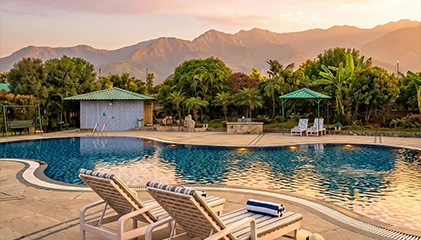
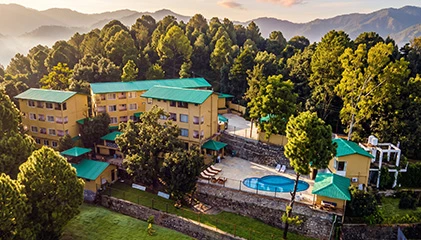
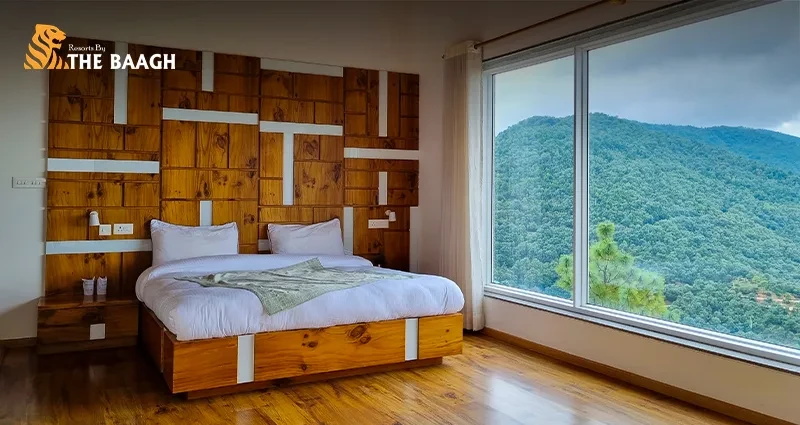
Cottages sit apart from one another. Lawns stay open. Trees are worked around instead of removed. The result is a property where you rarely hear a neighbour, and where the boundary between indoors and outdoors softens by design.
What This Looks Like in Practice
- Ground-level cottages with private sit-outs instead of stacked corridors
- Open dining decks rather than sealed banquet halls
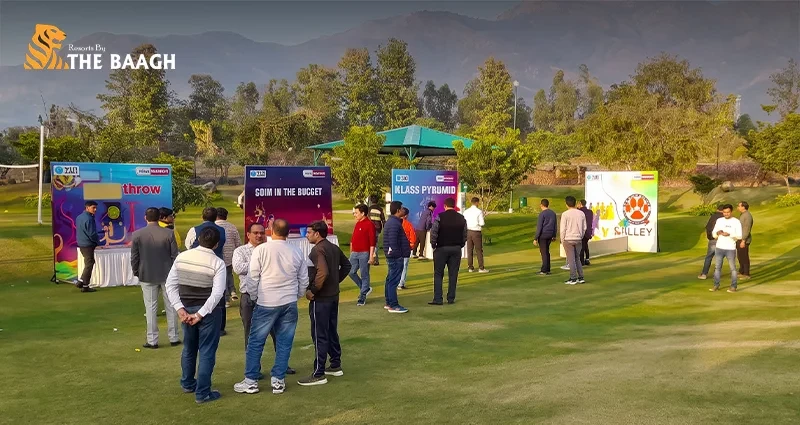
- Bonfire zones, orchards and walking paths built into the layout
- Fewer rooms overall, which keeps the property quiet even at full occupancy
Sustainability Is Operational, Not Decorative
This is where eco-friendly resorts separate themselves most clearly. In a city hotel, sustainability often means a card asking you to reuse towels. In Corbett, it is a licence to operate near a protected forest.
Nature resorts in the region typically run on:
- Solar water heating and low-consumption lighting systems
- Rainwater harvesting and treated water reuse for landscaping
- Strict single-use plastic restrictions across guest areas
- Waste segregation with organic composting on site
- Locally sourced produce, which cuts transport emissions and supports Ramnagar farmers
Genuine eco-friendly resorts also limit light and sound pollution after dark, because both interfere with nocturnal wildlife movement in the buffer zone.
The Staff Are Local, and That Changes Everything
A hotel concierge books you a cab. A resort naturalist tells you which pugmarks on the riverbank are fresh.
Most nature resorts around Corbett employ heavily from surrounding villages. Naturalists, drivers and guides here often carry a decade or more of field experience, along with formal certification from the forest department for zone entry. That knowledge is not something a training manual produces.
- Guides read alarm calls, not just maps
- Kitchen teams cook Kumaoni recipes learned at home
- Employment stays within the district, which strengthens local support for conservation
Experiences Replace Amenities
Ask a hotel what it offers and you get a list of facilities. Ask a wildlife resort and you get a list of experiences.
- Jeep safaris booked through official forest department channels
- Guided birding walks, with Corbett recording over 600 bird species
- River-side breakfasts and Kosi bank evenings
- Village walks, cycling routes and Kumaoni cultural evenings
- Nature interpretation sessions for children
Corbett was declared India's first national park in 1936 as Hailey National Park, and became the launch site of Project Tiger in 1973. That history is part of the guest narrative here, not a trivia card.
Service Feels Personal Because Scale Allows It
Large hotel accommodation properties depend on systems. Smaller nature resorts depend on people.
With fewer rooms, staff remember your name, your tea preference and your safari timing. Dining is often set-menu or semi-buffet, prepared fresh in smaller batches. Requests get handled by someone who is physically present rather than routed through three departments.
Resorts By The Baagh follows this format closely, keeping the property intimate enough that hospitality stays conversational rather than transactional.
Rhythm and Seasonality
Hotels operate identically in March and July. Resorts here do not.
- Peak season runs mid-October to mid-June
- Monsoon closes several safari zones for regeneration
- Rates, activities and menus shift with the season
- Core zone bookings often need advance planning of weeks
Planning around this calendar is part of the Corbett experience, and good resorts guide guests through it.
A Thought Worth Carrying
"In the end, we will conserve only what we love; we will love only what we understand; and we will understand only what we are taught."
Source: Baba Dioum, Senegalese forestry engineer, IUCN General Assembly, New Delhi, 1968.
This sums up the entire logic of nature resorts. By placing guests inside the ecosystem and pairing them with naturalists who explain it, these properties turn casual tourists into people who genuinely care about protecting Corbett.
Conclusion
The difference is not luxury versus simplicity. Many Corbett properties match five-star comfort levels. The difference is intent. A hotel is built to house you efficiently. A resort here is built to connect you to a forest that has been protected for nearly ninety years, and to do it without damaging what you came to see. That intent shows up in the architecture, the staffing, the sustainability systems and the pace of the day.
For anyone planning a Corbett trip, choosing a property that understands this distinction is the single decision that shapes the entire holiday.
Frequently Asked Questions
1. Are resorts in Corbett suitable for families with young children?
Yes. Most nature resorts offer ground-level cottages, open lawns, supervised activities and child-friendly menus, making them safer and more engaging than compact urban rooms for families travelling with kids.
2. How do eco-friendly resorts in Corbett manage waste and water responsibly?
They use rainwater harvesting, treated water for gardens, solar heating, plastic-free guest areas and on-site organic composting, ensuring minimal environmental load on the sensitive buffer zone surrounding the tiger reserve.
3. Does staying at a wildlife resort guarantee a tiger sighting?
No property can guarantee sightings, since tigers move freely across protected forest. However, experienced resident naturalists significantly improve tracking skills, zone selection and timing, which meaningfully increases your realistic chances.
4. Is resort hotel accommodation in Corbett more expensive than city hotels?
Rates vary widely by season and category. Resorts typically include meals, activities and naturalist support, so overall value often exceeds comparable city hotels once inclusions are properly compared.
5. When should I book my Corbett resort stay?
Book at least three to four weeks ahead for peak months between October and June, especially around weekends and holidays, since core zone permits and preferred cottages fill quickly.
Your Journey, Elevated
Turn Your Getaway Into
An Experience
An Experience
Leave the ordinary behind and discover journeys designed around the moments that matter. From stunning destinations to unforgettable stays, every detail is thoughtfully planned to make your escape feel truly special.
Whether you're looking for adventure, relaxation, or something in between, we're here to help you explore, unwind, and create memories worth taking home.